- AQL is a sampling plan: you inspect a set number of units from a lot and accept or reject the lot based on how many defects you find.
- General inspection level II is the usual default. Level I inspects fewer units and level III more, and special levels S-1 to S-4 are for destructive or costly tests.
- Most consumer product buyers use 0 for critical defects, 2.5 for major and 4.0 for minor, but the right limits depend on the product and the risk.
- Write the AQL level, the limits, the defect list and the golden sample into the purchase contract before production, not after the first complaint.
Buyers often write “AQL 2.5” into a purchase order without knowing what it commits them to. The factory reads it one way, the inspector another and the buyer a third. The first time a lot is rejected, the argument is about the wording, not the goods.
This guide explains how AQL sampling works, how to read the tables, which levels buyers usually choose for consumer products and what to put in the contract so an inspection report ends the discussion instead of starting it. It sits alongside golden sample approval, which gives the inspector the physical standard.
What AQL is
AQL means acceptable quality limit. It belongs to a family of attribute sampling plans, set out in ISO 2859-1 and in the US standard ANSI/ASQ Z1.4, which grew out of the older MIL-STD-105. The idea is simple. Checking every unit in a large lot is slow and costly, so you check a sample. The plan tells you:
- how many units to check, called the sample size;
- how many defects you can find and still accept the lot, called the accept number (Ac);
- the number at which you reject the lot, called the reject number (Re).
AQL is not a promise that every shipped unit is perfect. It is a rule for deciding whether a lot is good enough to ship. A lot with a defect rate near the limit passes most of the time, and one far above it usually fails.
Inspection levels
The inspection level, together with the lot size, picks the sample size. There are two groups.
- General levels I, II and III. Level II is the default. Level I uses a smaller sample and gives less confidence. Level III uses a larger sample and gives more.
- Special levels S-1 to S-4. These use very small samples. They suit tests that destroy the unit or cost a lot per piece, such as a lab test or a full disassembly.
Most consumer product buyers choose general level II for a first order, and move to level III if the product is high-risk or the factory has a poor record. If the history is good, a switch to level I can lower the inspection cost.
Sample size and accept numbers
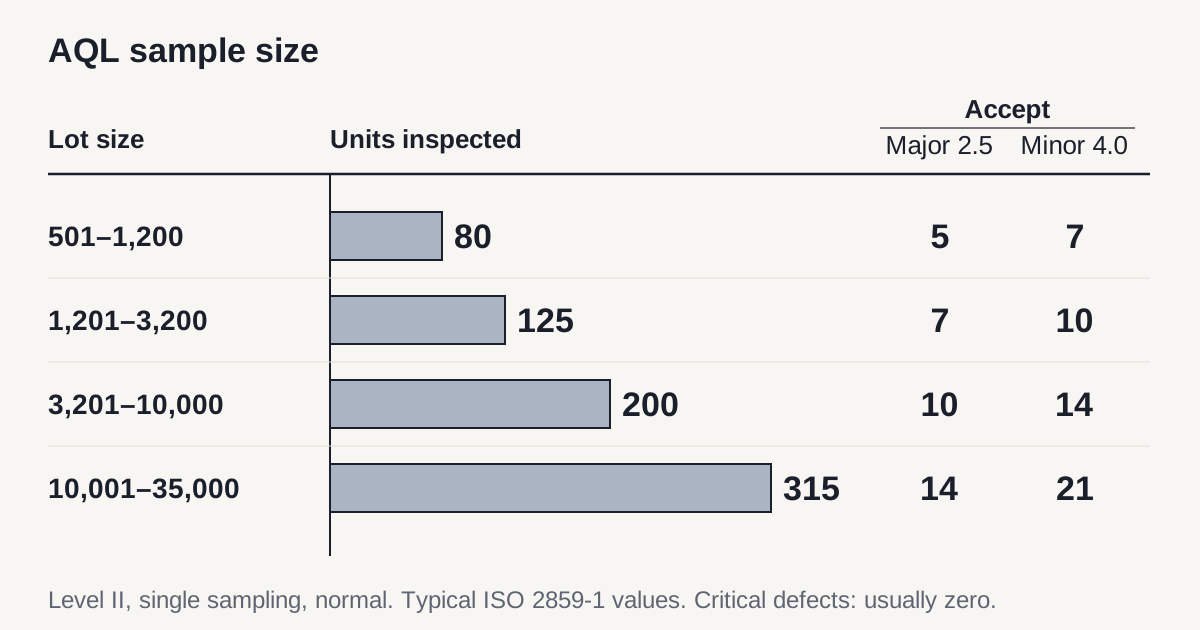
The table shows general inspection level II, single sampling, normal severity. The figures match the standard tables, and the limits shown are the ones most often used in consumer goods: 2.5 for major defects and 4.0 for minor defects.
| Lot size | Sample size | Major defects at AQL 2.5 (accept up to) | Minor defects at AQL 4.0 (accept up to) |
|---|---|---|---|
| 501 to 1,200 | 80 | 5 | 7 |
| 1,201 to 3,200 | 125 | 7 | 10 |
| 3,201 to 10,000 | 200 | 10 | 14 |
| 10,001 to 35,000 | 315 | 14 | 21 |
Read it like this: for a lot of 5,000 units at level II, the inspector pulls 200 units at random from the finished and packed cartons. If the inspector finds 10 or fewer major defects and 14 or fewer minor defects and no critical defects, the lot passes. One more major or minor defect and it fails.
Sampling must be random. The inspector should choose cartons from different pallets and positions, not the ones the factory has staged near the door. Plan for the inspection when at least 80 percent of the order is finished and packed, so the sample reflects the lot.
A few units are measured completely before volume starts, which is first article inspection.
Critical, major and minor defects
The AQL limits apply per defect class. Define the classes in the contract, with examples, so nobody argues over which class a defect belongs to.
- Critical. Likely to hurt the user or break a safety rule, for example a sharp edge on a child’s product, an exposed live part or a missing mandatory warning. Buyers normally accept zero.
- Major. Makes the product unusable, unsellable or clearly below spec, for example a cracked housing, a wrong color, a missing part or a broken closure.
- Minor. A departure from spec that does not affect use or sale, such as a small cosmetic mark in a hidden area or a light loose thread.
Where a defect sits on the unit matters. A scratch on the top face of a retail item may count as major, and the same scratch under the base as minor. Put the rule in the defect list with photos.
How to choose the limits
A common starting set for consumer products is zero critical, 2.5 major and 4.0 minor. Adjust by risk and by price point.
- Stricter, such as 1.5 or 1.0 for major. Higher-priced goods, products for children or items sold through retailers that chargeback for defects.
- Looser, such as 4.0 for major. Low-cost items, promotional goods or products where the buyer expects some cosmetic variation.
Stricter limits cost more, through larger rejection risk at the factory and sometimes a higher unit price. Looser limits cost more later in returns and reviews. Pick the level that fits your brand, not the one in a template.
Send a brief Send your brief
Normal, tightened and reduced inspection
The standard also allows the plan to change with history. After consecutive rejected lots, inspection moves to tightened, with lower accept numbers. After a run of accepted lots, it can move to reduced, with a smaller sample. For a single order the switching rules rarely matter. For a repeat program, agree whether you will use them and who tracks the history.
What to write in the contract
Put the inspection terms in writing before production starts.
- The standard used, for example ISO 2859-1 or ANSI/ASQ Z1.4, single sampling.
- General inspection level and the AQL limits for critical, major and minor.
- The defect list with photos, and the golden sample used as the reference.
- When the inspection takes place, such as when 80 percent of the order is packed, and who pays for it.
- What happens on a fail: rework and re-inspection at the factory’s cost, with a time limit.
- The shipping rule: goods do not ship until the buyer accepts the report or releases the lot.
Many buyers tie the balance payment to the inspection result. The factory then has a clear reason to meet the standard. Agree this as part of the payment terms discussed in what an ODM project costs.
A worked example
A buyer orders 5,000 units of a kitchen organizer. The contract says general inspection level II, zero critical, 2.5 major and 4.0 minor. The lot size of 5,000 falls in the 3,201 to 10,000 band, so the inspector takes 200 units at random from the packed cartons.
- The inspector finds no critical defects, 8 major defects and 12 minor defects. The accept numbers are 10 major and 14 minor, so the lot passes.
- In a second case the inspector finds 11 major defects. That is one above the accept number, so the lot fails, even though the minor count is fine.
After a fail the contract should say what happens. A common path is that the factory sorts the lot, replaces or reworks the defective units and asks for a re-inspection, at its own cost, within a set number of days. The buyer then decides whether to accept the re-inspection result. If the contract says nothing, the factory and the buyer negotiate under time pressure, which favors the party holding the goods.
Notice also what the pass does not say. A pass at 8 major defects out of 200 means about 4 percent of the sample had a major defect. The lot is accepted under the plan, but the buyer may still want a conversation about the cause, and a record to compare with the next order.
What an inspection covers beyond AQL
AQL sampling checks visible workmanship. A full pre-shipment inspection usually adds:
- A check of quantity, carton marks, barcodes and packing.
- A measurement check on critical dimensions, on a smaller sample.
- A function test on a set number of units.
- A carton drop test or a package integrity check.
- A review of the lab reports and certificates on file.
Hire an independent inspection company for this work and pay it directly. The inspector should report to you, with photos, and not to the factory.
Next step
Write the AQL clause, the defect list and the inspection timing into your brief, and keep a copy for the contract. Then send your brief. We reply within 24 business hours and match you with up to 3 Vietnamese ODM factories. You agree the inspection terms with the factory you choose and hire the inspector yourself.
Frequently asked questions
What does AQL mean?
AQL stands for acceptable quality limit, sometimes written acceptance quality limit. It is the worst average quality level that is still considered acceptable when lots are sampled repeatedly. In practice buyers use the term for the sampling tables that tell an inspector how many units to check and how many defects are allowed before the lot fails.
Which AQL inspection level should I choose?
General level II is the usual starting point for consumer products. Use level III for higher-risk or higher-value products, or when the factory has a poor record. Use level I when quality history is good and inspection cost matters. Special levels S-1 to S-4 apply to small samples, for example destructive tests.
Is an AQL of 2.5 the same as 2.5 percent defects?
Not exactly. The AQL figure is a quality level used to choose the plan, and the plan's accept number is what decides the outcome. A lot with a defect rate near the AQL has a high chance of passing, and a lot much worse has a low chance. AQL does not promise that every shipped unit is good, so keep the defect definitions and the golden sample in the contract.
Who should do the AQL inspection?
Buyers usually hire an independent third-party inspection company and pay it directly, so the inspector reports to the buyer and not to the factory. The factory also checks its own output, but its own check is not a substitute. odmvn.com does not inspect goods, so plan and budget for an independent inspector.