- The FDA does not approve finished kitchenware. It regulates the materials, so the supplier must show each material and the finished article meet the rules for the use.
- In the EU the framework rule is Regulation (EC) 1935/2004, and plastics have a detailed rule in Regulation (EU) 10/2011. Germany adds LFGB tests, which often include a taste and odor check.
- A test report covers the tested sample, so a change of resin, dye, coating or supplier can mean a retest.
- Ask the factory for material documents and a declaration of compliance, then book a lab test on the finished article yourself.

Kitchenware is one of the categories where a missing paper can stop a shipment. A customs hold, a marketplace listing removal or a retailer audit can all trace back to the same gap: the buyer cannot show that the material is suitable for contact with food. The fix is mostly paperwork and testing, planned early.
This guide explains the main rules for the US and the EU, what LFGB means in practice, how the rules differ by material and how to get the reports. It is a planning guide and not legal advice, so confirm the current text with your lab or importer. It connects to the wider testing plan in pre-launch product testing.
The basic principle
A food-contact article must not release substances into food in amounts that could harm health, change the food’s makeup or alter its taste and smell. Rules apply to the materials and to the finished article, including colorants, coatings, inks and adhesives that touch the food.
Two points follow:
- Compliance is by use. A bowl for cold salad, a pan for high heat and a baby bottle have different conditions, so a report must match the intended use.
- Reports cover samples. A report proves the tested sample met the limits. If the material or process changes, the proof may no longer apply.
United States
In the US, the FDA regulates the substances used in food-contact materials, mainly through the food additive rules in Title 21 of the Code of Federal Regulations. Plastics and polymers appear in the parts covering indirect food additives, for example Part 177 for polymers and Part 174 for general provisions. Silicone rubber articles intended for repeated use sit under a section within Part 177.
The FDA does not approve finished kitchenware or issue certificates for it. The manufacturer or importer must be able to show that each material complies for its intended use. For ceramics and glassware, the FDA applies action levels for lead and cadmium that leach from the surface, and the test is a leaching test with an acid solution.
State rules can add limits. California’s Proposition 65 covers lead and other listed chemicals, and several states restrict PFAS in cookware. Check the state rules for your sales channels.
European Union and Germany
In the EU, Regulation (EC) 1935/2004 is the framework for all food-contact materials. It requires that materials be safe, traceable and labeled. Regulation (EC) 2023/2006 sets good manufacturing practice. For plastics, Regulation (EU) 10/2011 adds a list of authorized substances and migration limits. It requires an overall migration limit and specific limits for named substances, and a declaration of compliance for plastic articles.
Other materials have narrower rules. Ceramics follow a directive that sets limits for lead and cadmium release. Metals and alloys, including stainless steel, are covered by guidance from the Council of Europe, with release limits for named metals. Silicone, wood and bamboo rely on the framework rule plus national guidance.
Germany adds the LFGB, the German Food and Feed Code. Buyers often request an “LFGB report” for kitchenware sold in Germany or for marketplaces that ask for it. A typical LFGB test package combines migration tests with a sensory test for taste and odor transfer. It is a lab report, not a government approval.
Rules and tests by material
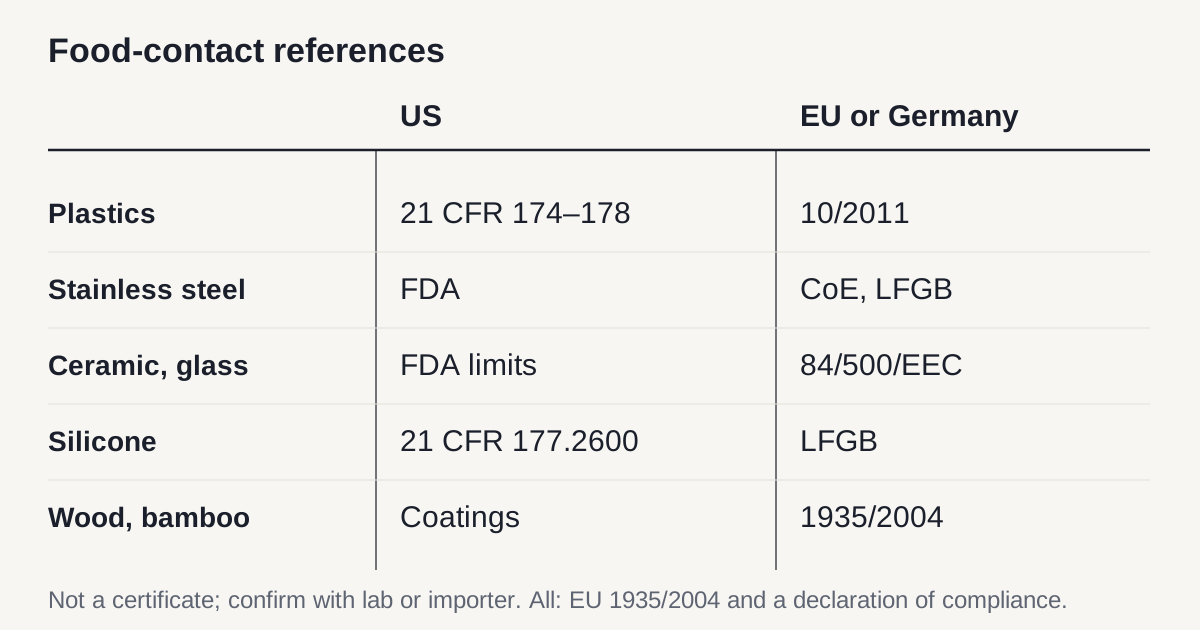
| Material | US reference | EU or Germany reference | Typical lab test |
|---|---|---|---|
| Plastics (PP, PC, ABS) | FDA 21 CFR Parts 174 to 178 | EU 10/2011, LFGB sections 30 and 31 | Overall and specific migration |
| Stainless steel | FDA food-contact rules | Council of Europe metals guidance, LFGB | Metal release in acid |
| Ceramic and glass | FDA lead and cadmium limits | Directive 84/500/EEC | Lead and cadmium leaching |
| Silicone | FDA 21 CFR 177.2600 | LFGB, BfR recommendation | Migration, volatile content |
| Wood and bamboo | Coating and glue compliance | EU 1935/2004 for coatings | Coating and adhesive migration |
The test uses food simulants, liquids that stand in for real food, such as dilute acetic acid for acidic foods, ethanol for alcoholic foods and a fatty simulant for oily foods. The article is held at a set time and temperature, and the liquid is analyzed.
What affects the result
- Resin grade and additives. The same plastic family can differ between grades, so name the grade.
- Colorants and inks. They can migrate, so food-contact grade colorants matter.
- Coatings and glazes. Non-stick coatings, lacquers and ceramic glazes need their own checks, for lead and cadmium among others.
- Heat and use. Higher temperature raises migration, so test at the real use temperature.
- Production control. Regrind, release agents and cleaning chemicals can add contaminants.
Wood and bamboo deserve a special note. The wood or bamboo itself is simple, but the lacquers, oils and adhesives that bind or finish it count as food-contact materials. Bamboo powder mixed with resin, sold as “bamboo fiber” tableware, has drawn enforcement attention in the EU. Check the current guidance before you accept such a product. Natural materials are covered in bamboo, rattan and acacia.
Send a brief Send your brief
Common mistakes
- Relying on the supplier’s old report. A report for another color, grade or product does not cover yours.
- Testing a prototype. Test the finished article made from production material, since coatings and colorants change the result.
- Ignoring the coating. A pan, mug or tray can pass as bare metal or ceramic and fail with its coating or glaze.
- Forgetting the use temperature. A test at room temperature does not cover a hot-fill or a dishwasher claim.
- Printing a claim first. Symbols, “BPA free” and “dishwasher safe” need support. Test first, then print.
- No change control. A silent switch of resin, dye or coating supplier can void the report.
Working with importers and platforms
Importers, retailers and online marketplaces set their own document requirements, and these are often stricter than the minimum law. Ask the buyer of your product, your importer or the marketplace policy page what they require: the type of report, the lab accreditation, the age of the report and whether a declaration of compliance must accompany each shipment. Send this list to the factory with the brief, so the samples and documents are prepared for the real audience.
What to ask the factory for
Before the sample stage, ask for:
- The resin, metal or coating grade, supplier name and datasheet for each food-contact part.
- Food-contact statements or declarations from the material supplier for your target markets.
- Existing test reports on the same material and finished article, with dates and the lab name.
- A written promise not to change material, color or coating supplier without a change order.
Treat existing reports with care. A report on a similar product, or on a supplier’s sample plaque, does not prove that your product complies. Check that the report names the same material, color and article, and that the lab is accredited under ISO/IEC 17025 for the methods.
Book your own test
For a new product, book a test on the finished article, made on the production tool and from production material. Do it before the pre-production approval so that a failure can still change the material. Typical turnaround is about 7 to 15 business days after the lab receives the samples, though complex programs take longer.
Pay the lab yourself and have the report sent to you. Keep the report with the product revision and lot, next to the golden sample. Retest after any change in material, color or coating, and note the change in the change order.
Labeling and instructions
Labels matter too. Many markets expect a symbol or wording for food-contact use, such as the glass-and-fork symbol in the EU, plus care instructions, such as dishwasher and temperature limits. Print only claims you can back with tests. A “dishwasher safe” claim, for example, needs a cycle test.
Checklist
- Target markets and use conditions written in the brief.
- Material grade and supplier documents for each food-contact part.
- Declaration of compliance where required.
- Lab test on the finished article, ordered by you.
- Retest rule for material, color or coating changes.
- Labels and claims backed by tests.
Next step
Put the food-contact markets and use conditions into your brief. Then send your brief. We reply within 24 business hours and match you with up to 3 Vietnamese ODM factories. You agree the materials, documents and tests with the factory you choose.
Frequently asked questions
Is there an FDA certificate for kitchenware?
No. The FDA does not issue approval certificates for finished kitchenware. It sets rules for the substances used in food-contact materials and expects the manufacturer and importer to show compliance. What you can ask for is a statement and test reports showing the materials and the finished article meet the FDA rules and that migration or leaching stays within the limits.
What is an LFGB test?
LFGB is the German Food and Feed Code. A test report marked LFGB usually means the sample was tested to the German rules for food-contact articles, which often include migration tests and a sensory check for taste and odor. It is a commonly requested report, but it is a lab report on a sample and not a government approval.
Do I need both FDA and LFGB reports?
It depends on where you sell. For the US, the FDA rules apply. For the EU, the EU rules apply, and Germany expects LFGB-style testing. Many buyers who sell in both regions ask for both sets of tests, because the extra cost is small compared with a rejected shipment or a platform listing removal. Ask your importer or marketplace what it requires.
What if I change the color or coating?
Colorants, coatings, inks and adhesives are part of the food-contact article. A change can alter migration, so ask the lab whether a retest is needed. Record the change in a change order and keep the earlier report on file with the revision it covers.