- An engineering change order, or ECO, is a written record of one change to a design, with its reason, affected parts, cost, schedule and approvals.
- The same change costs little before tooling, more after first samples and the most after mass production has started and stock exists.
- Steel can be removed from a mold easily but is hard to add, so changes that make a part thicker are cheaper than changes that make it thinner.
- Group changes into one numbered revision, update the golden sample and tell the inspector the new revision before the next shipment.
Design changes after approval are normal. A retailer asks for a different insert, a lab test shows a wall is too thin, a customer finds the handle awkward. The cost of the change depends less on its size than on when it happens and how it is handled. A change recorded in a clear order costs a known amount. A change requested in a chat message costs an argument.
This guide explains what an engineering change order contains, how cost grows by stage, how to handle tool changes and how to keep the standard, the inspector and the factory in step. It builds on the budget view in what an ODM project costs.
What an ECO is
An engineering change order is a written record of one change to a released design. Related terms include the change request, which is the proposal, and the change notice, which tells others the change is approved. In a small ODM project the three steps often sit on a single form.
The point is traceability. Every unit, tool and sample has a revision, and every revision has a record of what changed and why. When a defect shows up later, the record tells you which revision it belongs to.
What a complete ECO lists
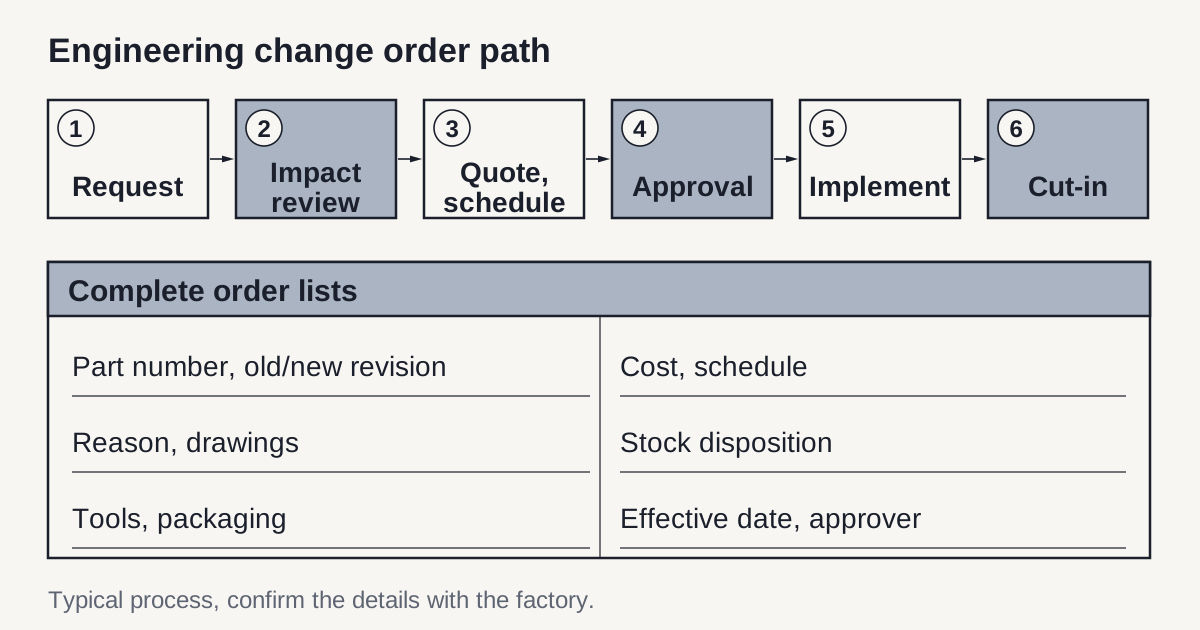
Ask the factory for a standard ECO form, or use your own. A complete one contains:
- Part number and revision. The old and the new revision letters or numbers.
- Description and reason. What changes, with drawings or photos, and why it is needed.
- Affected items. Tools, fixtures, parts, packaging, labels, test reports and the bill of materials.
- Cost impact. Tool modification, new samples, retest fees and any change in unit price.
- Schedule impact. Days added to sampling, tooling and delivery.
- Stock disposition. What happens to finished units and parts already made: use, rework or scrap.
- Effective point. The date, batch or serial number from which the new revision applies.
- Approvals. Signatures from the buyer and the factory.
Without the stock disposition and the effective point, the same change gets applied differently by different people.
How the cost grows by stage
The same change costs more as the project moves forward, because more things depend on the design.
| Stage | Example change | Typical impact |
|---|---|---|
| Before tooling | Wall thickness, hole position | Edit the 3D file, low cost, a few days |
| After tool design review | Add a rib, move a gate | Tool design edit, small cost, days |
| After first tool samples | Thicker wall, new logo area | Steel removal or insert, moderate cost, 1 to 2 weeks |
| After pre-production sample | Thinner wall, moved slide | Steel welding, high cost, 2 to 6 weeks, new samples |
| After mass production | Any shape change | New tool work plus rework or scrap of stock |
The cost rises because the steel is cut, samples are approved, packaging is printed and labs have tested the old revision. Each of those becomes a thing to redo.
The lesson is to find changes early. Prototype reviews, DFM reports and the first tool samples are the cheapest places to find them. The stages are covered in prototype, EVT and pre-production samples.
Tool changes: steel in, steel out
For injection molds, one rule shapes the cost. Removing steel from a cavity is easy. Adding steel is hard. If a wall must be thicker, the toolmaker mills away steel and the plastic fills the gap. If a wall must be thinner, the toolmaker has to weld steel into the cavity and re-machine it, which risks the tool surface and shortens tool life.
A good ODM factory knows this and leaves extra steel, called steel safe, on dimensions that may change. Ask whether your tool has steel-safe features at uncertain dimensions. The topic is covered in more detail in injection mold tooling cost.
Other tool changes, such as moving a gate, adding a slide or changing the texture, cost more because they touch several parts of the tool.
The approval path
A simple, repeatable path keeps changes controlled.
- Request. The buyer or factory describes the change with drawings or photos.
- Impact review. The factory checks tool, parts, packaging, tests and stock.
- Quote and schedule. The factory states cost and days in writing.
- Approval. Both sides sign the ECO. Work starts only after this.
- Implementation. Tool or process is changed and new samples are made.
- Verification. The buyer checks the new sample against the changed drawing.
- Cut-in. The new revision starts on the agreed date or batch.
Keep a single log of ECOs with number, date, revision, cost and status. A spreadsheet is enough.
Keep the standard in step
A change makes old references wrong. After each ECO that affects shape, material, color or packaging:
- Refresh the golden sample. Make a new approved sample and mark the old one as superseded. See golden sample approval.
- Update the inspection documents. Give the inspector the new revision, the defect list and the new reference.
- Check lab reports. Ask the lab whether the change needs a retest. Material, coating and structural changes often do.
- Update labels and packaging. If the product size, model name or spec changes, the box and label may change too.
If you skip these, the factory builds the new revision while the inspector checks against the old one.
Send a brief Send your brief
Avoid late changes
Most late changes come from decisions that were left open. Reduce them early.
- Freeze the specification before tooling, with a written sign-off.
- Test early prototypes with real users and in real conditions.
- Run the DFM review and ask for a list of risk points.
- Start lab testing at the design validation stage, as in pre-launch product testing.
- Collect all changes into one revision rather than sending them one by one.
Batching saves money. One tool modification that includes five changes costs less than five separate modifications, and creates less confusion about revisions.
A written design review before tooling prevents many changes; see the DFM checklist for consumer products and our guide to ODM product development.
Intellectual property and changes
If the factory proposes a change, ask whether it affects the ownership of the design or tool. Changes made by the factory’s engineers can create new design rights. The contract should state that changes to your product belong to you in the same way as the original design. See who owns the design in an ODM project.
A worked example
A buyer finds during DVT that a plastic latch breaks after a few hundred cycles. The factory proposes thicker latch walls, 0.4 mm more, and a small rib.
- The buyer raises an ECO request with a photo of the failure and the target cycle count.
- The factory reviews the impact: the cavity needs steel removed in two places, the latch drawing changes and the packaging does not change. The lab report for fatigue will be repeated.
- The factory quotes tool modification, new samples and the retest, with dates, and confirms that the unit price does not change.
- Both sides sign. The factory modifies the tool, makes samples and the buyer tests cycle life again.
- The new revision starts from the next production batch, the golden sample is replaced and the inspector receives the revised drawing.
Because the change thickens a wall, it removes steel and stays cheap. The same latch made thinner would have meant welding. The example shows why wall changes should lean toward more material in the first tool.
Who signs for what
Keep roles clear. The buyer approves function, appearance, cost and schedule. The factory approves feasibility, tool work and its own quote. If a designer or engineer outside the factory made the original design, ask for a short sign-off from that person too, so the drawings stay consistent. Where a third-party lab or inspector is involved, send them the signed ECO, because they need the revision number.
Checklist
- One numbered ECO per change or per grouped revision.
- Cost, schedule, stock disposition and effective point written down.
- Both sides signed before work starts.
- Golden sample and inspection documents updated.
- Lab retest question answered.
- ECO log kept in one place.
Next step
Write your change-control rule into the brief: one form, written cost and schedule, signed before work. Then send your brief. We reply within 24 business hours and match you with up to 3 Vietnamese ODM factories. You agree the change process and its costs with the factory you choose.
Frequently asked questions
What is an engineering change order?
An engineering change order, usually shortened to ECO, is the formal document that records a change to a product design after the design has been released. It names the part and revision affected, explains the reason, lists what else changes, gives the cost and schedule impact and carries the approvals of both buyer and factory. It stops changes from happening through informal messages.
Who pays for a change to the design?
The party that asks for the change normally pays for it. If the buyer asks for a new shape, the buyer pays the tool modification and new samples. If the factory needs a change because a tool or process fails to meet the agreed drawing, the factory normally bears the cost. Write who pays in the ECO before work starts.
How long does a tool change take?
Simple edits, such as removing steel for a thicker wall or changing a logo insert, often take one to two weeks. Larger changes, such as moving a slide or adding a cavity, can take three to six weeks. New samples add another one to two weeks. These are typical ranges, so ask the toolmaker for a date in the ECO quote.
What happens to stock made before the change?
The ECO must say. Options are to use the old units, rework them to the new revision or scrap them. The choice depends on whether the change affects safety, fit or appearance. Decide it before the new revision starts so finished goods and parts in stock do not turn into a dispute.