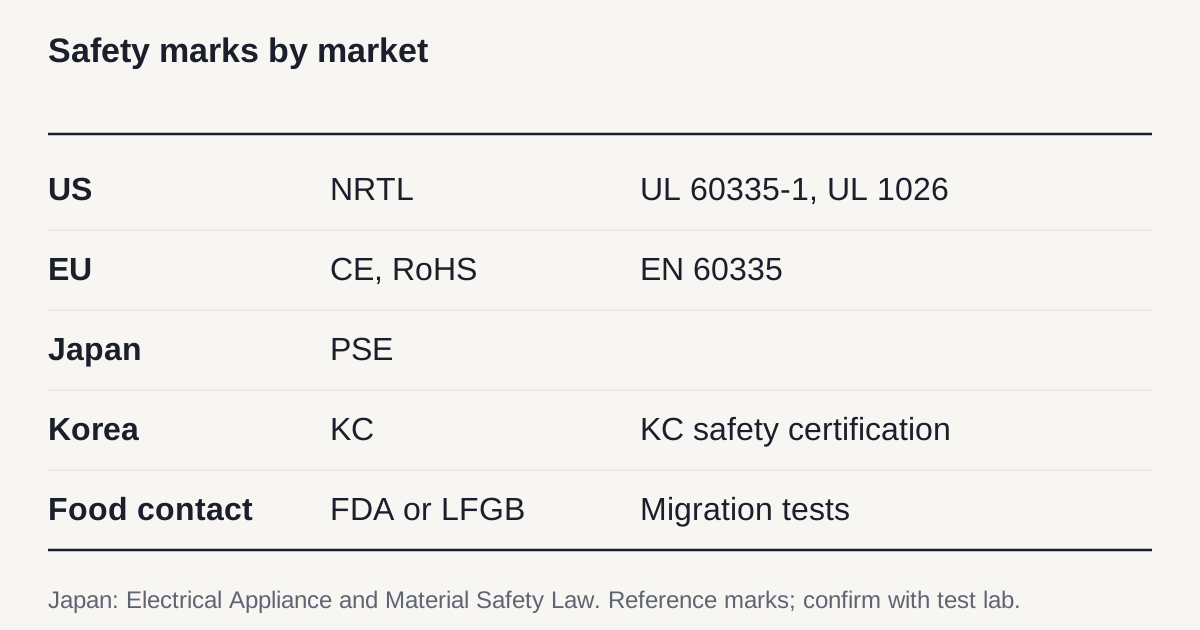
- Powered kitchen appliances need a safety mark for each market: NRTL listing in the US, CE with RoHS in the EU, PSE in Japan and KC in South Korea.
- Plastic housings, heaters and cords drive both tooling cost and certification. Choose pre-approved parts where you can, since they shorten the test path.
- Parts that touch food need their own material tests, separate from the electrical safety mark.
- Agree who holds the certificate and the test report before sampling, since the factory's existing listing may not cover your brand or model.

A kettle, blender, air fryer or rice cooker seems like an easy ODM project. The factory already makes a similar product, and you change the color and the logo. The difficulty lies in the electrical safety and the tools, which a design change can affect.
This guide covers safety marks by market, the parts that drive tooling and certification, food-contact requirements and a sample and test plan. For mold cost basics, see injection mold tooling cost.
What kind of appliance project you have
The route you choose changes cost, time and certification.
- Rebrand an existing model. You add your logo, color and packaging to a model the factory already sells. Fastest and cheapest. Certification may already exist for the model, but not for your brand.
- Adapt an existing platform. The factory changes the housing, controls or accessories on a proven electrical core. Tooling is partial and the core may stay certified.
- New design. A new housing, a new electrical layout or a new function. Highest cost, longest time and a full test path.
For first-time brands, adapting a proven platform is common, since it limits the electrical risk while giving a distinct look. Read ODM vs OEM vs contract manufacturing if the terms are new.
Safety marks by market
A powered appliance needs proof that it is safe to plug in. The mark and the process differ by market.
| Market | Typical mark | Typical standard family | Who issues proof |
|---|---|---|---|
| United States | NRTL listing (UL or ETL) | UL 1026, UL 60335-1 | Listing laboratory |
| European Union | CE marking and RoHS | Low Voltage and EMC Directives, EN 60335 | Manufacturer file with test report |
| Japan | PSE mark | Electrical Appliance and Material Safety Law | Registered body and importer |
| South Korea | KC mark | KC safety certification | Designated laboratory |
These are reference points, not a certificate. Rules change, and the exact route depends on the product type, so confirm with a test lab or your importer.
CE marking is a manufacturer declaration backed by a technical file and test reports, not a mark issued by an agency. That puts the responsibility on the brand that places the product on the market. Ask the test lab how the file should name you as the importer or manufacturer.
The parts that drive certification
Most of the test effort sits in a few components.
- Plug and cord. The plug must match the market, and the cord set usually needs its own approval. Voltage differs between markets, such as 120 V in the US and about 230 V in the EU.
- Heating element and controls. A thermal cut-off or fuse that stops overheating is central to the standards. Dry-boil protection matters for kettles. Overheat and tip-over protection matter for heaters and fryers.
- Plastic housing. The material needs a flame rating, such as UL 94 V-0, V-1 or HB depending on the location, or a glow-wire test under EN rules. A wrong resin can fail a test and force a new mold.
- Printed circuit board. Creepage and clearance distances, component approvals and EMC behavior.
- Battery, if cordless. Lithium cells need transport testing such as UN 38.3, plus electrical safety tests.
Pre-approved components, such as a cord set or a thermal cut-off that already carries a listing, shorten the test path. Ask the factory which components it uses and whether they carry the marks you need.
Tooling for appliance housings
Plastic housings, jugs, lids and buttons need injection molds. The housing is often the largest tooling cost in the project.
- Resin choice. Flame-rated resin may differ from the one in the look-alike sample. Choose it before the mold is cut.
- Heat zones. Parts near the heater need high-temperature resin or an air gap.
- Wall thickness and ribs. Thin walls warp and thick walls sink. The factory’s design team handles this, so ask for design-for-manufacturing feedback.
- Cavity count and steel. Low volumes suit a single-cavity mold in pre-hardened steel. The trade-offs are the same as in the tooling guide.
- Texture and color. Surface texture, gloss and color matching add to mold and sampling time.
Ask who owns the tooling, where it is stored and what happens if you move production. Write this into the agreement.
Food-contact parts
Many appliances touch food or drink. The electrical mark does not cover this.
- Jugs, bowls and baskets. Plastics, glass or metal that meet food.
- Seals and gaskets. Silicone or rubber that sits against hot liquid.
- Blades and inner surfaces. Stainless steel parts that meet acids and salts.
- Coatings. Non-stick or enamel layers on pans and baskets.
Ask for material declarations and migration test reports under the rules of your market, such as FDA requirements or the German LFGB. See food-contact materials for kitchenware for the test list. Stainless steel parts need grade checks too, as explained in the guide on 304, 316 and 201 stainless.
Send a brief Send your brief
Who holds the certificate
This question causes more delay than any technical one.
- Whose name is on the report? The factory’s, yours or both.
- Does it cover your model number? A new brand name usually means a new model number and a label change.
- What changes require a retest? A new cord, resin, supplier or PCB revision can trigger one.
- Who pays for retests and surveillance? Listings often need periodic factory checks.
Ask the lab what a brand change requires before you promise a launch date.
A sample and test plan
- Brief and platform choice. Features, target price, markets and certifications needed.
- Prototype. A working unit for function and ergonomics, often made without final tooling.
- Engineering sample. Built to the design, used for electrical and performance tests.
- Tooling and T1 samples. First shots from the molds, checked for fit, color and finish.
- Certification testing. Safety, EMC and food-contact tests at an accredited lab, using samples that match production.
- Pre-production sample. Made on the line with final parts and packaging. Approve it as a golden sample.
- Production and inspection. A pre-shipment check with function tests on each sampled unit.
Add performance tests that matter to customers: boil time, noise, temperature accuracy and cycle life of switches and lids. Pre-launch product testing lists drop, fatigue and lab reports to plan.
Packaging, manuals and labels
A powered appliance needs more printed content than most goods.
- Rating label. Voltage, power and the marks for the market.
- Manual. Safety warnings, use instructions and care, in the languages of the market.
- Packaging. Drop-tested carton, with inner protection for glass and cords.
- Energy or efficiency labels. Some product types need them in some markets.
Plan the artwork early, since marks and warnings need approved placement.
Common mistakes
- Assuming the factory’s certificate covers your brand. A new brand or model may need a new file.
- Choosing resin after the mold is cut. A wrong flame rating means a new tool.
- Skipping food-contact tests. The electrical mark does not cover them.
- Late lab booking. Test slots fill, and retests add weeks.
- Changing parts after approval. A new cord or board needs a review.
Checklist before you order
- Decide the route: rebrand, adapt or new design.
- List your target markets and the marks each needs.
- Ask for the certificate, the report and the component list.
- Choose flame-rated resin before cutting the mold.
- Request food-contact material reports for all wetted parts.
- Agree who holds the certificate and what triggers a retest.
- Book the test lab early and plan the sample stages.
Next step
Write down the product, the features, the target markets and the price you need. Then send your brief. We reply within 24 business hours and match you with up to 3 Vietnamese ODM factories. Certification, tooling and samples are agreed directly with the factory you choose. For the wider route, read ODM manufacturing in Vietnam.
Frequently asked questions
Do I need a UL listing to sell a kitchen appliance in the US?
There is no single federal law that requires a UL mark, but many retailers, marketplaces and insurers require a listing from a nationally recognized testing laboratory, such as UL or ETL. Without it, many channels will not accept the product. Check your retailer's requirements before you design the product, since the listing shapes the components you can use.
Can I use the factory's existing certificate for my own brand?
Sometimes, but not automatically. A certificate covers a specific model, factory and component list. If you change the housing, the cord, the label or the brand, the listing may need an update or a new file. Ask the factory to show the certificate and the report, and ask your test lab what a brand change requires.
How long does safety certification take?
It depends on the product and the lab. A simple appliance built with pre-approved components can take weeks. A new design with a heater, electronics or a battery can take a few months, and retests add time. Plan certification in parallel with sampling and book the lab early.
What is different about food-contact parts in an appliance?
Jugs, lids, baskets, blades and seals touch food and need separate material testing, such as migration tests under the rules of your market. The electrical mark does not cover this. Ask the factory which plastics, silicones and metals it uses and ask for material reports.