- Lead and cadmium can leach out of a glaze into food and drink, especially from under-fired glazes and bright colors that use cadmium.
- Limits depend on the article type and the market. They are checked by an acid leach test on the fired finished piece, not on the raw glaze.
- A supplier statement that a glaze is lead free is not proof. Ask for an accredited lab report on the actual production pieces, including decorations.
- Re-test whenever the glaze recipe, the colorant, the kiln or the body changes, and tie each report to a batch.
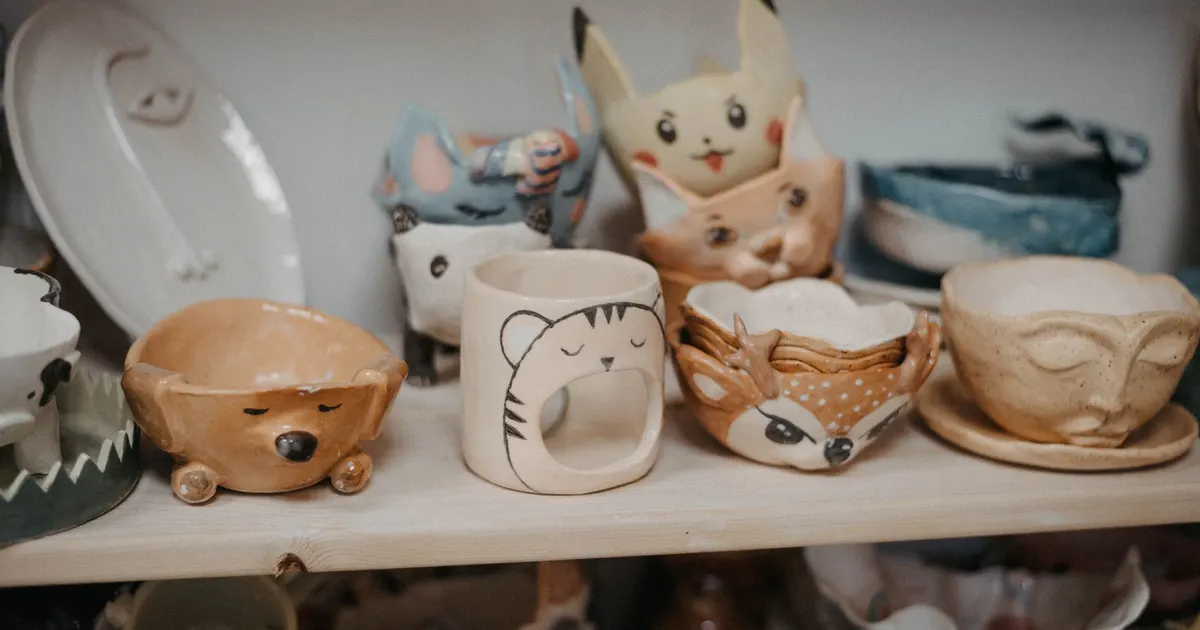
Ceramic tableware looks inert, but a glaze is a thin layer of glass that has to hold its chemistry under acids, heat and detergents for years. When it does not, lead and cadmium can leach into a coffee, a tomato sauce or a glass of wine. That is why ceramic is one of the most tested categories in food-contact goods.
This guide explains why glazes leach, how the limits are set, which tests to ask for and what to write in the order. It adds detail to the ceramic row in food-contact materials for kitchenware.
Why lead and cadmium end up in glazes
Lead oxide has been used in glazes for centuries because it lowers the melting point, gives a smooth, glossy surface and brightens colors. Cadmium compounds give strong reds, oranges and yellows that are hard to match with other pigments.
Both metals are toxic. Long-term exposure to lead is a concern in children and pregnancy, and cadmium builds up in the body. A fired glaze can hold them firmly when the recipe and the firing are right. A poorly formulated or under-fired glaze can release them, and acidic food and drink speeds up the release.
Modern factories use lead-free frits and cadmium-free colors for tableware. The issue today is rarely a deliberate lead glaze. It is contamination, a colorant that is not what it says, a recycled raw material or a firing that did not complete.
Stoneware, earthenware and porcelain
The body matters because it sets the firing temperature, and the firing sets how well the glaze matures.
| Body | Typical firing range | Typical use | Glaze risk note |
|---|---|---|---|
| Earthenware | About 1,000 to 1,150 °C | Decorative plates, planters, rustic tableware | Lower firing, more care needed to mature the glaze |
| Stoneware | About 1,200 to 1,300 °C | Mugs, bowls, baking dishes | Dense body, a well-matured glaze is durable |
| Porcelain | About 1,250 to 1,400 °C | Fine tableware, cups | Dense and white, durable glaze when fully fired |
These ranges are typical and vary by recipe. The lesson is that the glaze must be fired as intended. A factory that shortens the cycle to save fuel can raise leach results without changing the recipe.
How the limits are set
Limits are set per article type, because a flat plate, a deep bowl and a mug put different amounts of food and acid in contact with the glaze. They are also set by market, so one report does not fit every destination.
A few reference points.
- European Union. The directive on ceramic articles in contact with food sets limits by category. For lead, the usual figures are 0.8 mg/dm² for flatware, 4.0 mg/L for hollowware and 1.5 mg/L for cooking ware. For cadmium, they are 0.07 mg/dm², 0.3 mg/L and 0.1 mg/L. The general food-contact framework regulation also applies.
- United States. The FDA publishes guidance on lead and cadmium in ceramicware by article type. For lead in cups and mugs, the limit is 0.5 µg/mL. Ask the lab for the cadmium limits and the other categories from the current guidance.
- State and retailer rules. California Proposition 65 and some retailers set their own limits or require a warning. Check your channel.
Limits are updated from time to time, so treat the figures here as orientation and get the current table from your lab.
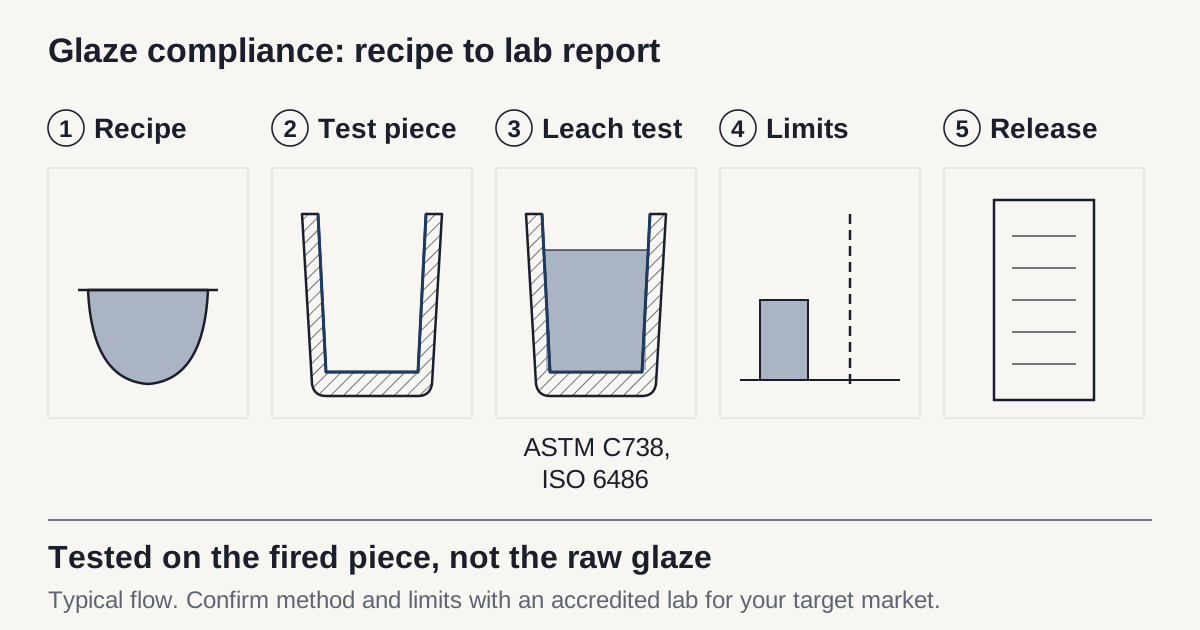
How the leach test works
The standard tests copy a worst case of acid contact.
- Prepare the sample. The lab takes finished, cleaned pieces from the batch.
- Fill or soak. The food surface is filled or covered with 4 percent acetic acid, which is similar to vinegar.
- Wait. The piece stands at room temperature for 24 hours, in the dark.
- Measure. The acid is analysed for lead and cadmium with a lab instrument.
- Compare. The result is reported per article and compared to the limit for its category.
ASTM C738 and ISO 6486 follow this outline. Some markets add a hot test for cooking ware and separate tests for the rim, since the lip meets the mouth. Ask the lab to name the method, the sample count and the article category used.
Decorations, colors and rims
A glaze that passes can sit next to a decoration that does not.
- Overglaze and on-glaze decals. They are fired at lower temperatures and often sit on top of the glaze. They carry colorants that need their own test.
- Metallic bands and gold or silver trim. Test the band and the area around it.
- Bright red, orange and yellow. These colors are the most likely to use cadmium in the colorant.
- Rims. In some markets the lip and rim have their own limit and test.
- Exterior and interior. If a decoration is on the outside only, say so, since the test may differ.
List every color and decoration zone in the brief. If the factory adds a color after sampling, test it again.
Send a brief Send your brief
What a supplier statement does and does not prove
A letter that says “our glaze is lead free” describes the intent. It does not describe the piece in your hands. The statement does not cover contamination, colorants, firing problems or a change of raw material.
An accredited lab report on the actual production pieces shows what was tested, with which method and against which limit. Look for the lab name and accreditation, the sample description, the method, the result for each article and the date. A report that lists a sample as “ceramic mug” with no batch reference can describe any mug.
Accredited labs are independent of the factory. Ask who ordered the test and who took the sample, since a sample the factory chose can differ from a sample from the line.
Durability tests that sit beside lead and cadmium
Leaching is not the only ceramic check.
- Thermal shock. A hot piece plunged into cold water should not crack or craze.
- Dishwasher durability. Repeated cycles should not dull the glaze or fade the decoration. A damaged glaze can release more metal later.
- Crazing. Fine cracks in the glaze trap food and can raise leach results.
- Chip and impact resistance. Rims and handles take knocks in use and shipping.
See pre-launch product testing for how to plan these alongside the chemical tests.
Writing it into the order
- Limits and method. State the market, the article category, the test method and the limit table.
- Sample plan. Number of pieces per batch and who takes them.
- Accredited lab. Name an independent lab or approve the factory’s choice in advance.
- Retest triggers. Any change of recipe, colorant, kiln program, body or supplier.
- Batch link. Each report ties to a production batch or date code.
- Remedy. Hold shipment on a failed test, and rework or remake at the factory’s cost.
The golden sample should be a production-fired piece with every decoration on it, and the test report should refer to the same recipe.
Common mistakes
- Testing a raw glaze. The leach test is for the fired article.
- Skipping the decoration. The rim or the red band is the likely failure.
- Accepting a report for a different shape. Limits depend on the article category.
- No retest after a recipe change. A new colorant source can change the result.
- Trusting a supplier letter. Intent is not a test result.
Checklist before you order
- Choose the market and the article category for each piece.
- Get the current limit table from your lab.
- List every glaze, color and decoration zone.
- Ask for an accredited report on production pieces.
- Plan thermal shock and dishwasher tests.
- Set retest triggers and a batch link.
- Write the remedy for a failed test into the order.
Next step
Write down each ceramic piece, the colors and decorations, the market and the quantity per design. Then send your brief. We reply within 24 business hours and match you with up to 3 Vietnamese ODM factories. Lab testing and batch approvals are agreed directly with the factory you choose. For the wider process, read ODM manufacturing in Vietnam.
Frequently asked questions
Can a ceramic mug be lead free and still fail a test?
Yes. A recipe with no added lead can still release small amounts of lead or cadmium if a colorant, a raw material or a recycled frit carries them. A glaze that is not fully fired can also release more. The only way to know is a leach test on the fired piece, so ask for a report on production pieces and not on a lab sample.
What is the difference between ASTM C738 and ISO 6486?
Both test the release of lead and cadmium from the food surface of a ceramic article by soaking it in a weak acid solution. ASTM C738 is used for much of the US market. ISO 6486 is used in Europe and many other markets. The limits that apply come from the regulation of the market, not from the test method. Ask the lab which method and which limit table it used.
Do decorations need their own test?
Yes. Decals, metallic bands and painted designs can carry lead or cadmium, particularly red, orange and yellow colors. Rims and exterior decoration have separate tests in some markets. List every decorated area in the brief so the lab tests the right zones.
How often should I retest?
Test the first production batch and any time the recipe, colorant supplier, kiln program or body changes. For continuing orders, many buyers retest once or twice a year or after any supplier change. Keep the report linked to a batch or a date so you can show what was tested.