- ABS is the balanced choice for housings that need a good surface, PP is the low-cost, chemical-resistant choice for containers and hinges, and PC is the tough, clear, heat-resistant choice at a higher price.
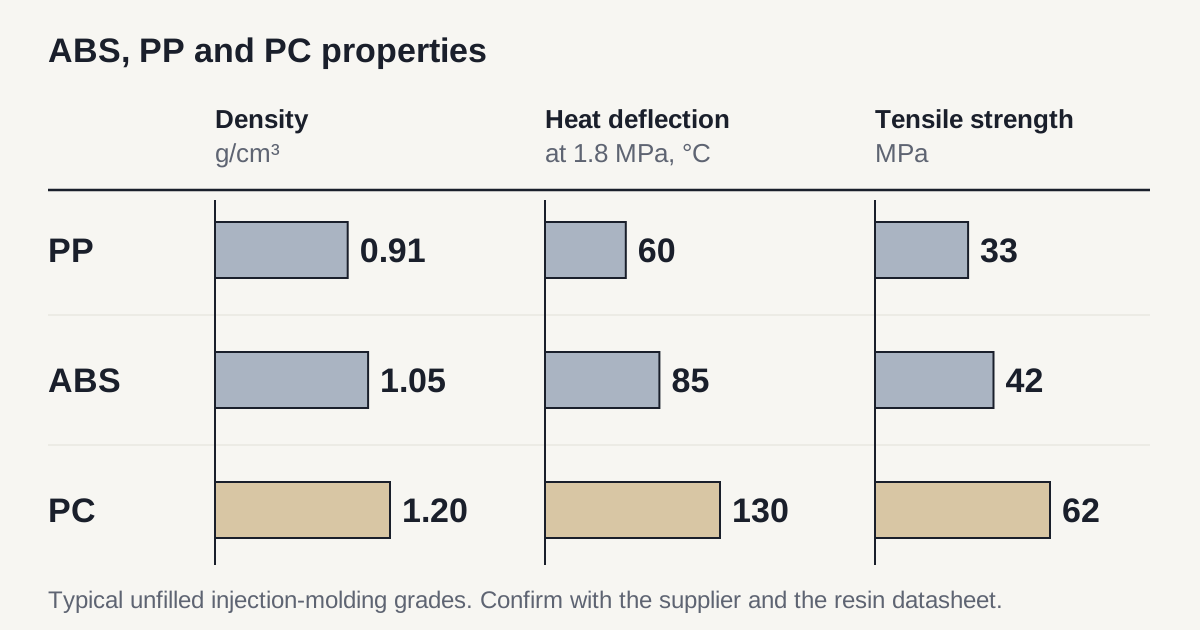
- Typical property values differ clearly: PP is lightest, PC has the highest heat and impact performance, and ABS sits between them.
- Finish matters: ABS paints, plates and glues easily, PP does not, and PC can stress-crack when it meets certain chemicals.
- Name the resin grade, not only the family, in the specification, and ask for the datasheet and lot certificate.
Resin choice looks like a technical detail until a housing cracks in the field, a lid warps in a dishwasher or a painted finish peels. In consumer ODM, three plastics cover a large share of injection-molded parts: ABS, polypropylene (PP) and polycarbonate (PC). Each has a clear strength and a clear weakness, and the right pick depends on what the product must survive.
This guide compares the three on the points a buyer can check: strength, heat, finish, chemical resistance, food contact, shrink and cost. It ties into the tooling decisions in injection mold tooling cost, since resin and mold steel are chosen together.
The short answer
- ABS. A balanced material with a good surface. It is the usual choice for housings, handheld products and parts that are painted, plated or glued.
- PP. A light, low-cost, chemical-resistant material. It suits containers, caps, living hinges and kitchen storage.
- PC. A tough, clear, heat-resistant material at a higher cost. It suits lenses, clear covers, impact-prone parts and higher-temperature use.
Blends such as PC/ABS combine properties and are common in appliances and electronics housings.
Typical properties
The table shows typical values for unfilled injection-molding grades. Actual figures vary by grade, supplier and test method, so use them to compare families, and read the datasheet for the grade in your quote.
| Property | PP | ABS | PC |
|---|---|---|---|
| Density (g/cm3) | About 0.90-0.91 | About 1.04-1.06 | About 1.20 |
| Tensile strength (MPa) | About 30-35 | About 40-45 | About 60-65 |
| Heat deflection at 1.8 MPa (deg C) | About 55-65 | About 80-95 | About 125-135 |
| Impact resistance | Moderate, drops with cold | Good | Very high |
| Mold shrinkage | About 1.0-2.5 percent | About 0.4-0.7 percent | About 0.5-0.7 percent |
| Transparency | Translucent | Opaque | Clear grades available |
| Relative resin cost | Lowest | Middle | Highest |
Three lessons come out of the table. PP is the lightest, which helps for large or hand-held parts. PC wins on strength and heat. ABS shrinks little and holds tight dimensions well.
Strength, impact and temperature
Impact resistance decides drop performance. PC takes hits that crack ABS, and ABS takes hits that crack unmodified PP in cold conditions. PP, by contrast, flexes without breaking, which is why it is the standard choice for living hinges, the thin strip that folds thousands of times on a box lid.
Temperature matters as much. A part that sits in a hot car, near a heating element or in a dishwasher needs a material that holds shape at that temperature. Compare the heat deflection value with the real service temperature, with a margin. Ask for the flame rating, such as a UL 94 class, when the part sits near heat or electronics.
Finish and assembly
Surface needs often decide the material before strength does.
- ABS takes paint, plating and printing well, and glues or welds readily. That is why it is common for visible housings and trim.
- PP has a low surface energy, so paint and glue struggle to stick. It needs surface treatment such as flame or plasma for printing, and fastening is usually by snap fit or mechanical joints.
- PC paints and prints acceptably, polishes to a clear finish and can be solvent-bonded, but some solvents and adhesives cause stress cracking.
Texture shows differently by resin. A fine texture hides marks on ABS and PP, while PC shows flow lines and sink marks more.
Chemical resistance and food contact
PP resists many acids, bases and household chemicals, which is why it is common in kitchen and storage products. ABS resists some chemicals but is attacked by solvents such as acetone and some cleaners. PC is vulnerable to some cleaners, oils and solvents, which can cause crazing or cracks.
For food-contact parts, the resin grade, colorants and additives all matter, and the finished article needs testing for the target market. Clear PC raises a further question for many buyers, because some retailers and customers prefer BPA-free materials for drinkware. Copolyester and other clear resins are common alternatives. The rules and tests are covered in food contact materials for kitchenware.
Cost and weight
PP has the lowest resin price per kilogram and the lowest density, so a part of a given volume weighs less and costs less in material. ABS costs more, and PC costs the most. Resin is only part of the unit price. A harder resin may need a harder mold steel, a longer cycle or a drier process, as noted in the tooling guide. Compare unit prices from factories, not resin prices alone.
Resin prices move with the oil market and supply. Ask for a quote with a validity date, and ask whether the price is tied to a resin index.
How to choose
Start from the use case, then check the finish and the market.
| If the part is | Start with | Check |
|---|---|---|
| A visible housing, painted or plated | ABS or PC/ABS | Flame rating, drop test |
| A kitchen container or lid with a hinge | PP | Food-contact grade, heat |
| A clear cover, lens or guard | PC | Chemical exposure, UV grade |
| An impact-prone case or handle | PC or PC/ABS | Cost, cold impact |
| A low-cost toy or storage item | PP or ABS | Safety tests for children |
| An outdoor part | UV-stabilized grade of any | UV and color fade test |
Add UV stabilizers for anything used outdoors, since many unmodified grades yellow and weaken in sunlight.
Send a brief Send your brief
Fillers, blends and recycled content
The base resin is only part of the story. Fillers, blends and recycled content change the properties.
- Glass fiber. Raises stiffness and heat resistance, and wears the mold steel faster. Common for structural parts and not for visible surfaces, since fibers can show.
- PC/ABS blends. Combine the surface of ABS with the impact and heat of PC, and are common in appliance and electronics housings.
- Flame-retardant grades. Needed near heat or electronics. They often cost more and are less tough, so test the exact grade.
- Recycled grades. Post-consumer or post-industrial recycled resin can vary by lot in color and properties. If you plan a recycled-content claim, ask the supplier how the content will be documented.
Design rules that depend on the resin
The same shape does not work in every plastic. A few rules guide the first design review.
- Wall thickness. Keep walls even. Thick sections sink and warp, and the problem is worse in PP because of its higher shrinkage.
- Draft angle. Walls need a slight taper so the part ejects. Textured faces need more draft than polished ones.
- Ribs and bosses. Ribs add stiffness without thick walls, and screw bosses need a ring of support to avoid cracks, especially in PC.
- Living hinges. A PP hinge is a very thin web, often a fraction of a millimeter thick, molded in one piece with the lid. ABS and PC do not make durable living hinges.
- Sharp corners. Add radii. PC and ABS crack from sharp inside corners under load.
- Shrink allowance. The mold is cut slightly larger than the part to allow for shrink, and the factor depends on the resin, so a change of resin means a changed mold dimension.
Ask the factory for a DFM report that mentions the resin and the design points above.
Common mistakes
- Choosing by price per kilogram. A cheaper resin that needs a rework costs more than a dearer one that works.
- Naming the family only. “ABS” covers many grades with different flow, impact and flame ratings.
- Skipping chemical tests. PC and ABS parts that meet cleaners or oils need a test before approval.
- Ignoring outdoor use. Sunlight yellows and weakens many grades without UV stabilizers.
- Changing resin late. A resin swap changes shrink, color and strength, and usually needs new samples.
What to put in the specification
- The resin family and grade name, not only the family.
- Color, by reference swatch, and whether it is by masterbatch.
- Flame rating if the part is near heat or electronics.
- Food-contact requirement and target markets.
- Recycled content, if any, and how it will be proven.
- A request for the datasheet and a lot certificate at delivery.
Ask the factory which resin supplier and grade it uses, and whether it will keep to that grade for the whole run. A silent switch to a cheaper grade is a common cause of quality drift. Resin changes after approval go through a change order, see engineering change orders in ODM projects.
Next step
List your use conditions in the brief: drop height, temperature, chemicals, finish, market and food contact. Then send your brief. We reply within 24 business hours and match you with up to 3 Vietnamese ODM factories. You agree the resin grade and its datasheet with the factory you choose.
Frequently asked questions
Which is stronger, ABS or polycarbonate?
Polycarbonate is tougher in impact and holds its strength at higher temperatures, so it usually outperforms ABS for drop-prone or heat-exposed parts. ABS is easier to mold, paint and glue and costs less. Many appliance housings use a PC/ABS blend to combine the two. The right choice depends on drop height, temperature and finish.
Is PP safe for food contact?
Polypropylene is widely used for food containers, because it resists many chemicals and is stable in normal use, but safety depends on the specific resin grade, colorants and additives. Ask the factory for food-contact documentation for the exact grade and have the finished article tested. See the food-contact guide for market rules.
Why does polycarbonate sometimes crack in service?
Polycarbonate can develop stress cracks when molded-in stress combines with certain chemicals such as some cleaners, oils or adhesives. Good part design, correct molding and chemical checks reduce the risk. If a product will meet cleaners or solvents, test the exact grade with those chemicals before approving production.
Can I choose the plastic or does the factory decide?
In an ODM project you can specify it, and the factory will often propose one based on the design and cost. Put your requirements, such as drop height, heat, finish and market rules, in the brief and ask for the grade and datasheet in the quote. A change of resin later usually means new samples and tests.