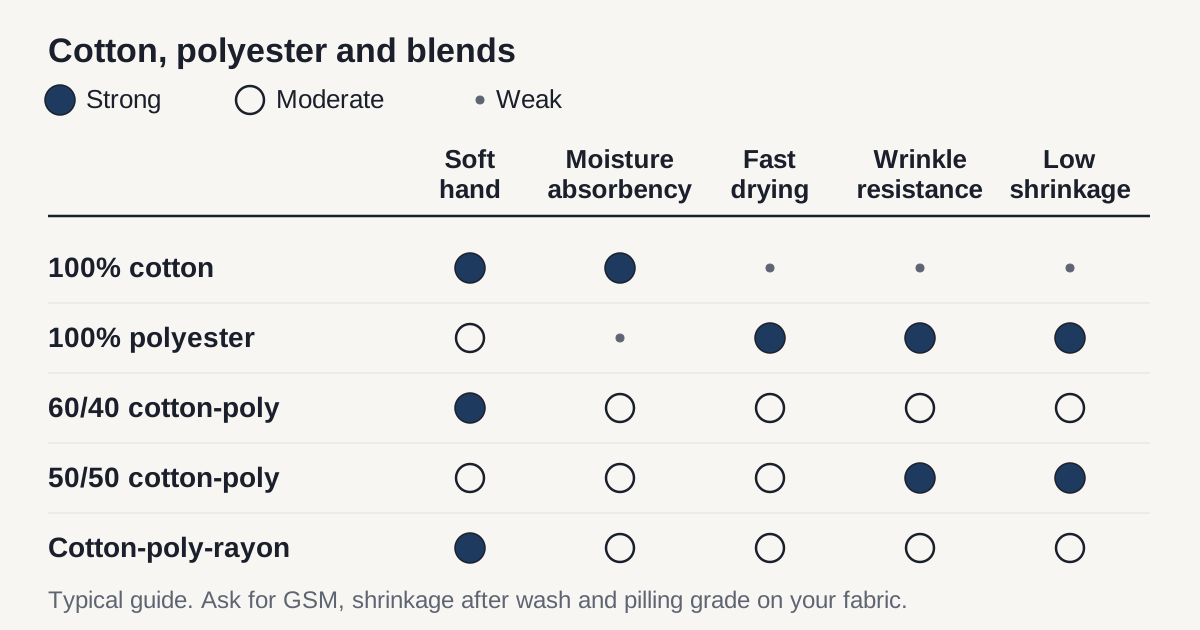
- Cotton gives soft feel and absorbency but shrinks and wrinkles. Polyester dries fast and holds shape but absorbs little moisture. Blends trade between the two.
- Fiber content is only part of a fabric spec. GSM, yarn count, construction and finish decide how the textile feels and wears.
- Ask for lab results on shrinkage, color fastness and pilling for the fabric you will actually receive, not for a similar one.
- Label the fiber content exactly as the market requires, and approve a fabric swatch in writing before bulk cutting starts.
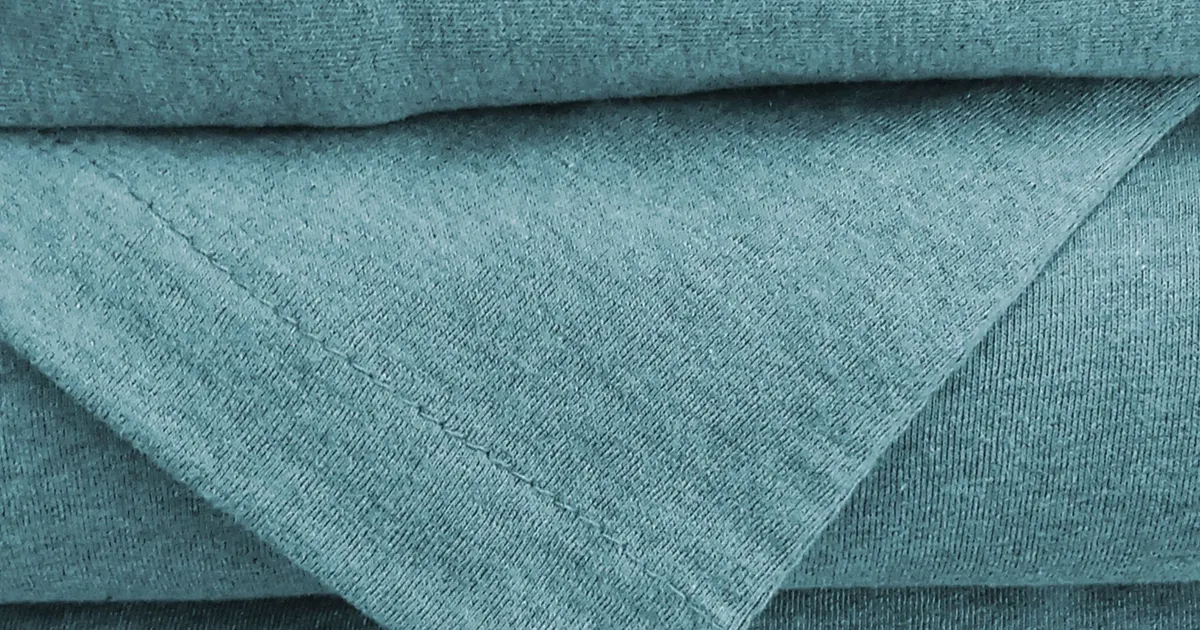
A private label tee, tote or throw blanket is only as good as the fabric inside it. Buyers often compare quotes by fiber name, such as cotton or polyester, and miss that the same name covers fabrics that feel and wear very differently. The surprise arrives with the first wash.
This guide compares cotton, polyester and the common blends, explains the numbers on a fabric spec, lists the tests worth requesting and shows how to label the fiber content. It pairs with golden sample approval, which applies to fabric as much as to hard goods.
Cotton, polyester and blends in plain terms
Cotton is a natural fiber from the cotton plant. It feels soft, absorbs moisture well and breathes. It wrinkles easily, can shrink in the first wash and dries slowly.
Polyester is a synthetic fiber made from petrochemicals or recycled plastic. It resists wrinkles, holds its size, dries quickly and takes strong colors. It absorbs little moisture, so it can feel less comfortable next to the skin in heat.
Blends mix the two. Common ratios include 60/40 and 50/50 cotton and polyester. A blend takes some softness from cotton and some stability from polyester. Tri-blends add a third fiber, such as rayon, for drape.
A useful number is moisture regain, which describes how much water a fiber takes up from the air. Cotton is around 8.5 percent and polyester around 0.4 percent under standard conditions. That gap explains why cotton feels cooler and polyester dries faster.
What each fiber gives you
| Property | Cotton | Polyester | 60/40 cotton-poly blend |
|---|---|---|---|
| Soft hand feel | High | Moderate | High |
| Moisture absorbency | High | Low | Moderate |
| Drying speed | Slow | Fast | Moderate |
| Wrinkle resistance | Low | High | Moderate |
| Shrinkage risk | Higher | Low | Moderate |
| Typical products | Tees, towels, bedding, totes | Sportswear, bags, outerwear linings | Work shirts, uniforms, hoodies, tees |
These are typical comparisons, not guarantees. Yarn quality, knit or weave and finishing change the result.
Numbers on a fabric spec
Fiber name alone is not a specification. Ask for these items.
- GSM. The weight in grams per square meter.
- Yarn count. The thickness of the yarn, written in different systems for cotton and polyester. A finer yarn usually gives a softer, smoother fabric.
- Construction. Woven fabrics such as poplin or twill, or knits such as jersey, rib or fleece. Knits stretch and can curl at the edge. Wovens keep their shape but wrinkle more in cotton.
- Width. The usable width of the roll, which sets how many pieces fit on a cut and so the fabric cost per unit.
- Finish. Brushing, enzyme wash, pre-shrinking and softener treatments change feel and shrinkage.
A short spec line might read: “Single jersey, 100 percent combed cotton, 160 GSM, pre-shrunk, enzyme washed, 180 cm width”. Two factories that quote against the same line are comparable.
If the factory buys fabric against a published price, see price adjustment clauses in manufacturing contracts.
Tests worth requesting
Request lab reports on the fabric you will receive, not on a similar roll from last season.
- Dimensional change. Shrinkage after home laundering, using a standard method such as AATCC 135 or ISO 6330. Specify the number of washes and the temperature.
- Color fastness. Resistance to fading and bleeding in washing, rubbing, perspiration and light. The ISO 105 series covers these tests.
- Pilling. The tendency to form small balls on the surface, tested by a method such as ISO 12945-2. Polyester and blends can pill more than long-staple cotton.
- Fabric weight and construction. Measured GSM and yarn counts against the spec.
- Fiber content. A lab check that the blend ratio matches the label.
- Restricted substances. Tests for dyes and chemicals required by the market you sell in.
Your test lab can advise which tests suit your product. For the wider testing plan, read pre-launch product testing.
Shrinkage, the most common surprise
Most complaints about private label textiles that start with “it shrank” come from fabric that was not pre-shrunk or a cut pattern that did not allow for shrinkage.
- Ask whether the fabric is pre-shrunk or compacted before cutting.
- Ask the factory to run a shrinkage test on the bulk fabric, not only on the sample.
- Set a limit and a method, for example a maximum percentage change in length and width after a stated wash.
- For fitted items, allow for shrinkage in the pattern or choose a fabric that moves less.
A test run before cutting costs little. Finding the problem after 3,000 pieces are sewn does not.
Send a brief Send your brief
Dye lots and shade matching
Fabric is dyed in lots, and a new lot can differ slightly in shade from the last one. For a single color across a large order, ask that all the fabric come from one dye lot, or from lots that were matched against the approved swatch.
- Approve a physical swatch, a lab dip or a strike-off and keep a sealed copy. This is the same idea as a golden sample.
- Agree a color tolerance, using a spectrophotometer reading or a visual standard under a set light.
- For repeat orders, ask the factory to match to your sealed swatch and not to the last shipment.
Prints, embroidery and finishes have the same issue, so approve them at the same stage.
Labeling fiber content
Most markets require a label that states the fiber content. The rules differ. The United States has the Textile Fiber Products Identification Act, and the European Union has Regulation 1007/2011. Both require names and percentages in a set format. Care labels are required in many markets too.
- State the fibers in descending order by weight with exact names, such as “cotton” and “polyester”.
- Do not round up or use broad terms that the rules do not allow.
- Check the care instructions against the actual wash tests.
- Ask your test lab or importer to review the label before you print it.
A wrong fiber label is a compliance problem and can stop a shipment.
Inspection and fabric defects
Fabric defects, such as slubs, holes, stains and shade variation, are checked at the fabric stage and again on the finished goods. Agree who inspects the roll and with which method before cutting starts. The same AQL sampling idea applies to finished units, with defect lists written for textiles, such as skipped stitches, open seams and puckering.
Common mistakes
- Quoting by fiber name only. Without GSM and construction, quotes are not comparable.
- Approving a sample made with another fabric. The sample was cut from a hand-picked roll that production will not match.
- No shrinkage limit. A tee that shrinks a size is a return.
- Changing mills mid-order. A new fabric source changes color, hand feel and size.
- Copying a label from another product. The blend may differ.
Checklist before you order
- Choose the fiber for the use, not only the price.
- Write a full fabric spec: construction, GSM, yarn count, width and finish.
- Request lab results for shrinkage, color fastness and pilling.
- Approve a sealed swatch and agree a color tolerance.
- Plan the fiber label and the care label for your market.
- Ask where the fabric is made and who the mill is.
- Fix the dye lot rule and the defect list in the order.
Next step
Write down the product, the fabric you have in mind with GSM if you know it, the quantity per style and the market. Then send your brief. We reply within 24 business hours and match you with up to 3 Vietnamese ODM factories. Fabric sourcing, lab tests and approvals are handled directly between you and the factory you choose. For the private label route, see private label manufacturing in Vietnam.
Frequently asked questions
What is GSM and why does it matter?
GSM means grams per square meter, the weight of the fabric. It is the quickest way to describe how light or heavy a fabric is. A light jersey for a summer tee is often around 120 to 160 GSM, and a heavy hoodie fleece can be 280 GSM or more. Two fabrics with the same fiber and the same GSM can still feel different, so always approve a physical swatch.
Is a cotton polyester blend better than pure cotton?
It depends on the use. A blend wrinkles less, shrinks less and dries faster than pure cotton, and often costs less. Pure cotton feels softer and absorbs more moisture. For towels and bedding, cotton is the usual choice. For work shirts, sportswear and bags, a blend or pure polyester is common.
How much shrinkage is acceptable?
There is no single number. For woven shirts and knit tees, buyers often set a limit in the range of 3 to 5 percent in length and width after a standard wash, and a tighter limit for fitted items. Write the limit and the test method into the specification, and test the fabric before cutting. Shrinkage found after the garments are sewn is expensive to fix.
Where does the fabric come from for a Vietnamese factory?
Vietnamese factories often cut and sew fabric that is made elsewhere, and some use local mills for certain knits. Ask each factory where the fabric is woven or knitted and where the yarn comes from, since this affects lead time, cost and in some markets duty rules. Do not assume the origin of the fabric is the origin of the sewing.