- Furniture ODM works two ways: pick and adapt a factory design, or brief a new design. The first is faster and cheaper, the second gives you a unique product.
- MOQ in furniture is often set by the container, not by the piece. A mixed 20 ft or 40 ft container lets you test several designs together.
- Finish, moisture content and joint design decide whether a piece survives shipping and a heated home. Ask for them in the specification.
- Wood legality papers, formaldehyde rules and tip-over or upholstery standards depend on the market, so confirm them before sampling.

Furniture is one of the oldest export categories for Vietnamese factories, and it is a good fit for ODM. Many factories hold a catalog of designs and the skills to adapt them, and buyers can launch a small range without paying for full product development. The details that cause trouble are rarely the design itself. They are the container, the finish, the wood and the paperwork.
This guide explains the two ODM routes for furniture, how MOQ really works, what finish and wood choices mean and which compliance papers to plan for. It builds on bamboo, rattan and acacia in Vietnam ODM for natural materials and on ODM project cost for budgeting.
Two ways to start
Adapt a catalog design. The factory shows a piece it already makes. You change dimensions, wood, finish, hardware or details, and add your label. Tooling and jigs often exist already, so samples are quick and the cost is lower. The risk is that other brands may sell a similar piece.
Develop a new design. You bring a sketch, a reference or a drawing. The factory makes a prototype, revises it and builds the jigs and templates for production. You get a distinct product. The cost and time are higher, and the first piece usually needs two or three rounds.
Many brands start with an adapted catalog piece to learn the process and test the market, then commission a new design for the second range. For a clear definition of the routes, see ODM vs OEM vs contract manufacturing.
MOQ is often a container question
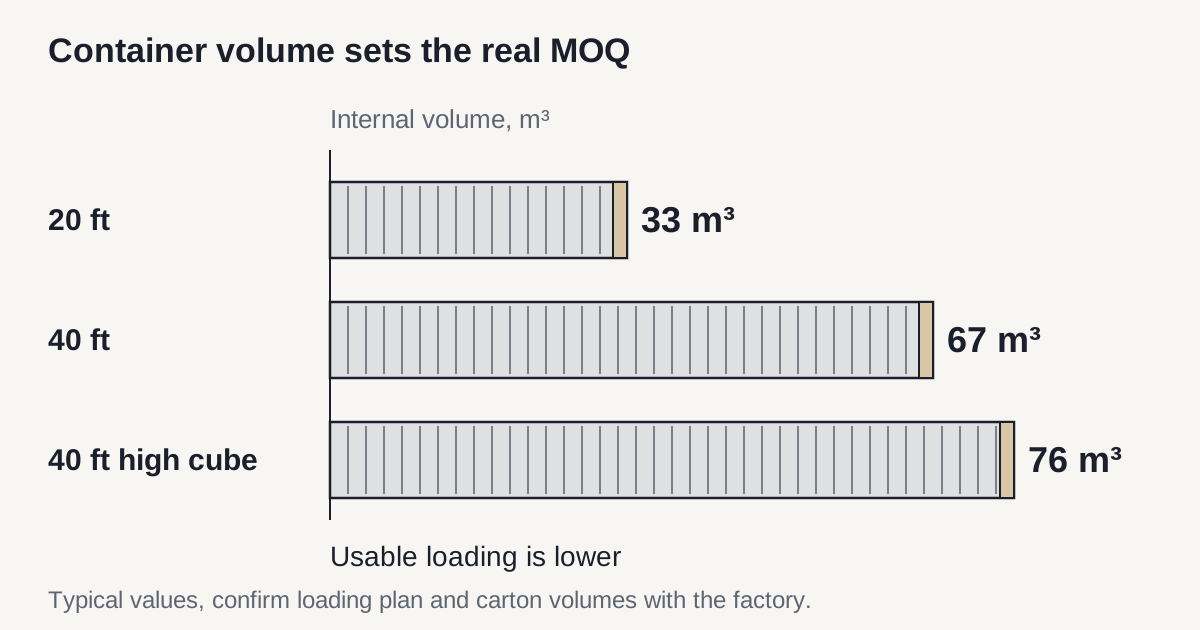
Furniture is bulky, so freight shapes the order. Many factories quote a minimum per container, since a half-empty container makes the freight cost per piece rise. A typical sea container holds the following.
| Container | Internal volume | Common use |
|---|---|---|
| 20 ft | About 33 m³ | Small first order, a few designs |
| 40 ft | About 67 m³ | Standard order, mixed or single design |
| 40 ft high cube | About 76 m³ | Tall or bulky items, large orders |
Usable loading is lower than the internal volume. Flat-pack packs well, while assembled upholstery packs poorly.
A mixed container can hold several designs and finishes, which suits a brand testing a range. Ask the factory how it counts MOQ: per design, per finish, per container or by value. Ask which items can share a container and what the extra cost of mixed loading is.
Woods and panels
Wood choice sets the look, the weight and the price.
- Rubberwood (Hevea). A light-colored hardwood that comes from plantation trees, common in tables, chairs and cabinets. It stains evenly.
- Acacia. A harder wood with strong grain, used for tables, boards and outdoor pieces. See the natural-materials guide linked above.
- Oak and ash. Usually imported, used for higher-priced pieces with a clear grain.
- Plywood, MDF and particleboard. Used for panels, backs and drawer bottoms. The glue system affects emissions.
Ask for the species, the grade and whether the wood is kiln-dried. Kiln drying to a moisture content in the typical range of 8 to 12 percent reduces cracking and warping after the piece reaches a dry, heated market. Ask the factory to measure it, and write the target in the specification.
Finish options
The finish protects the wood and sets the feel. The right one depends on the use and the market.
| Finish | Look and feel | Typical use | Watch for |
|---|---|---|---|
| Natural oil or wax | Matte, natural | Tables, chairs, interior pieces | Needs upkeep, marks easily |
| Water-based lacquer | Clear, low odor | Indoor furniture | Lower scratch resistance than some alternatives |
| Polyurethane lacquer | Durable, many gloss levels | Tabletops, high-wear items | Yellowing over time in light colors |
| Stain with topcoat | Colored grain | Chairs, cabinets | Color match between batches |
| Paint | Opaque color | Cabinets, kids’ furniture | Chipping at edges, lead-free paint rules |
Approve the finish on the real wood and the real species. A stain looks different on rubberwood and on oak. Ask for the finish sample on the same material as production, and keep a sealed copy.
Joints, hardware and tolerances
A piece that looks good in a showroom can wobble in a home. Check these points in the sample.
- Joints. Mortise and tenon, dowels, screws or knock-down fittings. Ask which joint is used at the load points.
- Hardware. Hinges, slides, bolts and cam locks. Ask for the brand or the type and the cycle rating if it is a drawer or a hinge.
- Tolerances. Gaps, flatness and squareness. A table that rocks is a return.
- Load. For chairs, shelves and tables, agree a load test and a pass limit.
Flat-pack needs extra care. Holes must align within a small tolerance, and the instructions must match the real hardware. Build the first piece from the box, as a customer would, before you approve.
Send a brief Send your brief
Packing for the sea
Furniture damages in transit more often than most goods.
- Corner and edge protection. Foam, cardboard or molded pulp at the corners.
- Inner packing. Plastic film or paper against rubbing, with a dry pack for moisture.
- Carton strength. Thicker board for heavy pieces, with a drop test on a sample carton.
- Labeling. Item code, piece count (1 of 2), orientation arrows and your brand marks.
The packaging stages in retail packaging development apply to furniture cartons as well, including the drop test.
Compliance to plan for
The rules depend on the market and the product. Plan for these early, since they can change the material choice.
- Wood origin. The US Lacey Act requires an import declaration for plant products. The EU has timber and deforestation rules. Ask for species, origin and supplier papers, and check the current dates and scope with your importer.
- Formaldehyde. Panels such as plywood, MDF and particleboard fall under emission limits. The US has rules for composite wood products, and the EU uses emission classes such as E1.
- Safety standards. Clothing storage units in the US have a tip-over standard, ASTM F2057. Upholstered furniture in California has flammability rules under TB 117-2013. Office furniture may refer to BIFMA tests.
- Finish and paint. Lead limits and restricted substances for paint, especially on children’s furniture.
Ask your importer or a test lab to confirm which of these apply to your product and your market. Do not rely on a factory statement.
A simple sample plan
- Brief. Dimensions, wood, finish, load, market and target price.
- Sample one. A first piece, checked for look, joints and size.
- Revision. Correct dimensions, joints, hardware or finish.
- Pre-production sample. Made on production jigs, with the final finish and packing. Approve it as a golden sample.
- Production and inspection. A pre-shipment check, with the sampling plan agreed in advance.
Plan more time than for small goods, since finish drying, wood conditioning and sea freight add weeks.
Common mistakes
- Choosing by photo. A piece that looks right in a picture can be wrong in size, weight or comfort.
- Ignoring moisture. Wet wood warps in a heated market.
- Approving the finish on the wrong wood. The stain changes with species.
- Forgetting the container. An order that fills 60 percent of a container is expensive per piece.
- Late compliance. Learning about wood papers after production is a delay.
Checklist before you order
- Choose adapt or new design.
- Set a target size, wood, finish and load.
- Ask each factory how it counts MOQ and container loading.
- Fix moisture content, joints and hardware in the specification.
- Plan carton design and a drop test.
- Confirm wood origin, emission and safety rules for your market.
- Approve a sealed pre-production sample.
Next step
Write down the piece, the dimensions, the wood and finish you prefer, the target price and the market. Then send your brief. We reply within 24 business hours and match you with up to 3 Vietnamese ODM factories. Samples, contracts and shipping are agreed directly with the factory you choose. For the wider route, read ODM manufacturing in Vietnam.
Frequently asked questions
What woods do Vietnamese furniture factories use?
Common choices are rubberwood (Hevea), acacia, oak, ash and pine, plus plywood and MDF for panels. Rubberwood and acacia are widely grown in Vietnam. Imported oak and ash are used for higher-end pieces. Ask each factory for the species, the origin and the legal papers, since the buyer in some markets must show where the timber came from.
What is the typical MOQ for furniture?
It depends on the piece and the factory. Many factories quote MOQ per container, often a 20 ft or 40 ft container that can mix several designs. Simple wood items may be available in smaller lots per design. Ask each factory for the MOQ per design and per container, and whether you can mix finishes inside one container.
Should I choose flat-pack or assembled furniture?
Flat-pack, also called knock-down, packs much more densely, so freight cost per piece is lower. It needs clear assembly instructions and tight hardware tolerances. Assembled pieces cost more to ship and arrive with more damage risk, but need no work from the customer. Upholstered furniture is usually shipped assembled.
How long does furniture development take?
For a new design, a common plan is a first sample in several weeks, one or two revisions, a pre-production sample and then production and shipping. Adapting a catalog design is faster. Ask each factory for a timeline with checkpoints, and allow extra time for finish approval and wood drying.